
Fossil capital and climate denial in Saskatchewan
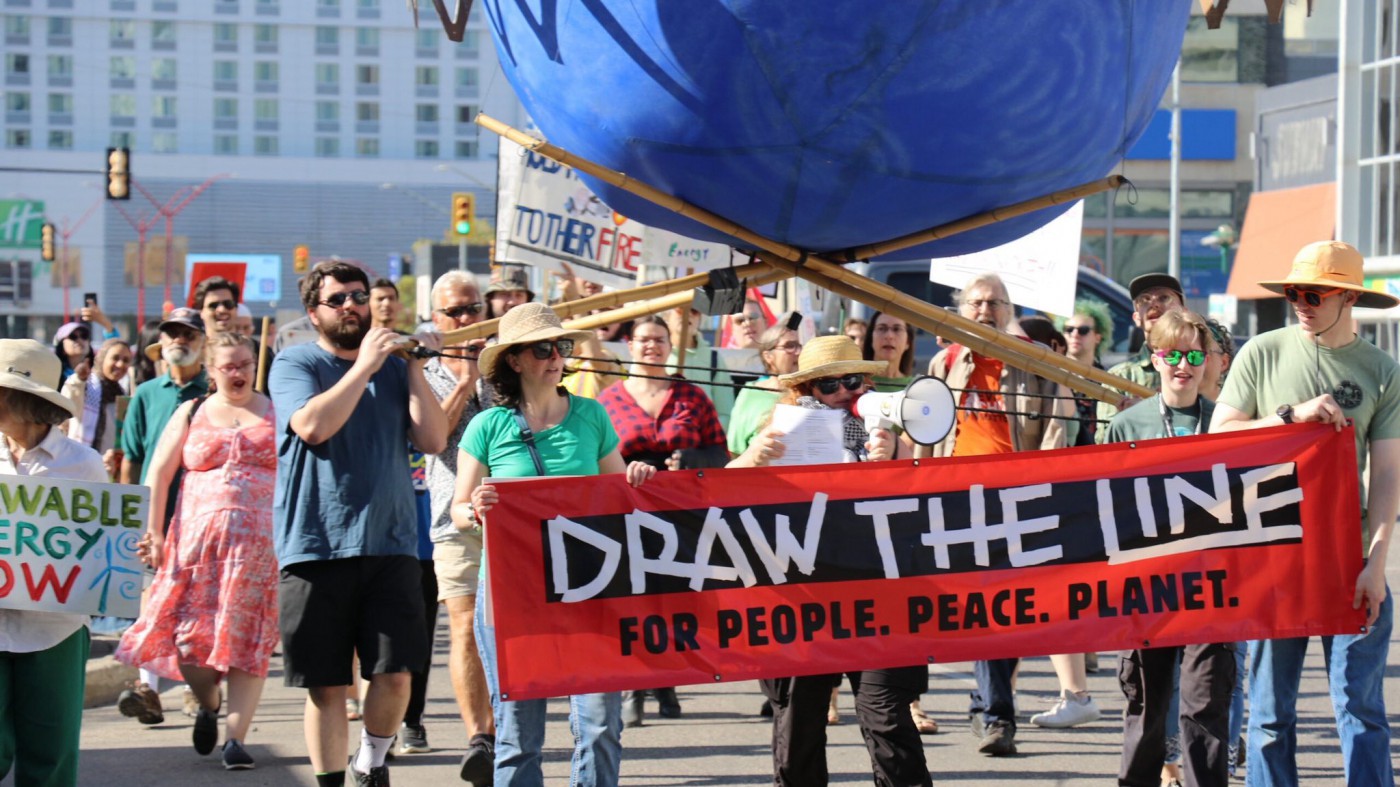
Environmental awareness groups Climate Justice Saskatoon and Saskatoon Climate Hub took to the streets September 20, 2025 in protest against the provincial government’s continued inaction against climate change. Photo from Climate Justice Saskatoon/Facebook
In a summer in which the climate crisis continued to grow, with devastating fires decimating our forests and communities, smoke filling our lungs, and drought choking our crops, on June 18, 2025, the Saskatchewan Party threw literal fuel on the fire. They quietly announced that they would be extending coal-fired power in Saskatchewan beyond the federally-established 2030 shutdown deadline - a coal power phase-out begun under Stephen Harper’s Conservative government in 2012 – doing so in a private letter to Crown employees with no official announcement to the public. The decision is not only remarkably reckless, but also a violation of Canada’s Criminal Code, as pointed out by former Liberal Minister of Environment and Climate Change Steven Guilbeault in 2023. Scott Moe responded “come get me,” a continuation of the Sask Party’s politics of animosity toward Ottawa as a way to deflect responsibility and accountability.
It is not only petty federal-provincial antagonism driving this decision. Looking at the politics, policies, and individuals connected to the Sask Party since their election in 2007, their dedication to coal power should come as no surprise. The party has connections to fossil fuel capitalists, resource barons, and right-wing reactionaries, all of whom have pushed us to stay dependent on fuel that is destructive on an existential scale.
Sask Party leading us further into climate catastrophe
In Saskatchewan, the campaign to deny climate change – and our disproportionate contributions to it – can be traced back to the election of the then faux-centrist, now strongly right-wing Saskatchewan Party in 2007. The Sask Party has spent the last 18 years peddling a disingenuous climate platform, as they lead us further into the inescapable repercussions of their continued inaction. They have failed to meet any self-imposed emissions targets; wasted public funds on failed court battles opposing federal climate policy; justified Saskatchewan’s carbon emissions because there are “much dirtier products in other areas of the world”; sabotaging efforts toward and refused to invest in renewable energy to reduce emissions and provide inexpensive, reliable energy for our province; latched onto dying concepts such as “clean coal” and “sustainable” or “ethical” fossil fuels; and fearmongered among workers in the fossil fuel industry, promising economic collapse should Saskatchewan switch to renewable energy.
After 18 years of greenwashing, delay, and denial, the Sask Party remains committed to total inaction on climate change, actively stonewalling and preventing meaningful action. Premier Scott Moe, formerly the Minister of Environment, continues to push the same script as his predecessors in government, opposing federal clean electricity regulations and the 2030 coal phase-out, policies aimed at establishing clean, reliable, and affordable electricity. He has loudly and falsely claimed that zero-emission electricity generation by 2035 and a goal of net-zero by 2050 is “unrealistic and unaffordable,” even though specific pathways for Saskatchewan to achieve a clean, affordable, and reliable grid by 2035 exist for the government to follow. The provincial government has opted to simply ignore all evidence of feasible clean energy sources, choosing instead to continue burning coal. To say this is irresponsible is an understatement; it is criminal.
[...] the Sask Party remains committed to total inaction on climate change, actively stonewalling and preventing meaningful action.
Minister of Crown Investments Corporation Jeremy Harrison says the rationale for continuing to generate coal power, which he adds we are “blessed” to have, is based on the need for “reliable and affordable power generation along with energy security.” In the same letter, Harrison makes a note of the alleged intermittency and unreliability of renewables, more of the same tired and deceptive rhetoric that has been in play since 2007.
Green energy: fiscally and environmentally responsible
Reliable and affordable power generation does exist, through renewable energy, storage, and grid infrastructure. In contrast to coal power, which is being phased out even in petrostate economies like Alberta, renewables are the fastest-growing and cheapest investments in electricity and energy currently available. They’re vastly outpacing projections in costs and implementation, while creating zero emissions to generate energy.
Our province isn’t “blessed” with coal; it is cursed with its devastating impacts on our health, environment, and, if we aren’t proactive in pivoting, to the economy. The true Saskatchewan blessings are in renewables, with world class wind resources and the highest solar potential in Canada. A common argument is that our cold climate, which has been consistently warming, is no place for renewables. This purposefully ignores that wind and solar generation are possible year-round, especially with appropriate winterization, investment, development, and storage.
Even with billions in subsidies and infrastructure, coal, oil, and gas don’t make financial sense when compared to renewable electricity, making further investment into coal costly and reckless. Globally, solar power is now 41 per cent cheaper and wind power 53 per cent cheaper than the lowest cost fossil fuel, according to the International Renewable Energy Agency. Nationally, this could mean renewable investment opportunities of $14 to $20 billion per year for wind, solar, and storage, with the potential for 250,000 to 350,000 full-time equivalent job years. The figures speak for themselves: with the most fossil fuel-intensive grid, Saskatchewan’s average electricity price is 21 cents per kWh, nearly double the rate of Manitoba’s predominately renewable power, with a price of 11 cents per kWh.
Globally, solar power is now 41 per cent cheaper and wind power 53 per cent cheaper than the lowest cost fossil fuel [...] Nationally, this could mean renewable investment opportunities of $14 to $20 billion per year for wind, solar, and storage, with the potential for 250,000 to 350,000 full-time equivalent job years.
The Saskatchewan Party has refused to pioneer or invest in renewable energy solutions for 18 years, instead working on carbon capture, gas plants, and now, more coal. The economics of the coal decision are so obscene that Brett Dolter, a professor of economics at the University of Regina, compared it to “Blockbuster Video doubling down on building new VHS-rental stores in an era of Netflix ... It is a waste of Saskatchewan ratepayers’ and taxpayers’ money.”
A billion dollar disappointment
An even larger waste of resources has been the province’s investment in unreliable, unproven, and ineffective carbon capture at Boundary Dam Power Station. The province has proclaimed the success of carbon capture and storage, claiming it is capable of capturing up to 90 per cent of emissions. In reality, Boundary Dam has only captured, on average, 57 per cent of its goal of one million tons of CO2 per year over 10 years. This disappointment lines up with numerous warnings that carbon capture is not the silver bullet for climate woes that our leaders claim it to be. It is frustrating to imagine the progress in renewable energy, grid upgrades, connections, and storage options that could have been invested in and developed over the past 10 years instead of banking on a single billion-dollar project directed at appeasing our provincial coal barons. The province claims that Boundary Dam generates enough power to service up to 100,000 homes. In contrast, the Seven Stars Energy Project, a wind energy project underway in the Weyburn area by Six Nations Energy Development LP and Enbridge, will reportedly power the exact same number of homes with zero emissions, for an anticipated “hundreds of millions” of dollars, well below the billion dollars or more for carbon capture.
The province’s poor financial management doesn’t stop at money already spent; it also includes growing future costs of climate inaction. Scientists have long stressed not only the climate costs of pursuing coal, but also the unmanageable looming financial and social costs pursuing it will rack up. Saskatchewan politicians frequently cite the six-figure union jobs that would be lost in a transition away from coal. Conveniently ignored is the fact that workers in those high-paying jobs will not be able to hold on to that money if climate change continues accelerating. Inflation created by fossil fuel markets and their artificial scarcity, as critically examined by professor Jim Stanford, robs workers of their wages and allows the industry to pass costs down to all of us at the gas pump, the grocery aisle, and on utility bills. Damage from increasingly frequent extreme weather events like fires, floods and storms, and the costs to our infrastructure, roads, homes, health care, and water and food supplies are passed on to us through taxes or loss of services. The feedback loops that are created are not only climatic, but also social and economic.
Conveniently ignored is the fact that workers in those high-paying jobs will not be able to hold on to that money if climate change continues accelerating.
Writing about environmental costs in the form of increased insurance prices, Gemma Boothroyd points out that weather events that were once happening every fifty years are now occurring every three to five years, resulting in “Saskatchewan’s average insurable losses (insurance companies’ anticipated payouts) [having] soared by 302 per cent over the last 30 years compared to the period prior”. This will increasingly impact everyone except the extremely wealthy, who aim to insulate themselves from disaster. “Their extreme wealth and privilege… make them obsessed with insulating themselves from the very real and present danger of climate change, rising sea levels, mass migrations, global pandemics, nativist panic and resource depletion”, as writer Douglas Rushkoff summarized in his exploration of billionaires and their impacts on society. Our quiet Prairie province is not immune to this exploitation and downward spiral. Every inch of our land, water, air, and labour will be pillaged for profit, not for our own benefit despite what may be promised, but for powerful capitalists.
The logic behind the Sask Party’s decision to pursue coal cannot be reconciled with goals of affordability, reliability, or security, or for economic, health, or climate reasons. In fact, all existing evidence indicates that this decision will be expensive, destabilizing, and harmful, indicating that the Sask Party’s true goal is climate delay and denial at great cost to us all. Rather than undertaking any true leadership, which involves making hard short-term decisions for long-term benefits they may not get to see, they continue to appease those with money and prestige. They have dug in their heels against any meaningful or effective climate action, whether policy or technology, kicking and screaming at the thought of giving up fossil fuels in favour of clean energy.
Environmental concerns are labour concerns
In the face of the province’s coal decision taking us a colossal step backwards, climate organizers must examine the reality of our situation: climate pedagogical efforts meant to persuade decision makers and the public have failed to create the necessary mobilization behind policies or keep even lukewarm climate-centered political actors in power, as observed in the recent federal election and the push for climate policy reversals. Mainstream climate politics have often centred on de-politicized and frictionless actions: technological solutions, individual responsibility, overdependence on technocracy, and public policy lobbying. Writers and researchers, such as geographer Holly Jean Buck, acknowledge the challenges of transforming our fossil economy into a green one, highlighting the need for carbon removal technology to be implemented at some scale as part of that transformation. However, instead of advocating for frictionless solutions, they are clear that these technologies must be worker- and community-led and under public ownership.
Rather than undertaking any true leadership, which involves making hard short-term decisions for long-term benefits they may not get to see, they continue to appease those with money and prestige.
To build a worker-led transformation of our economy to combat climate change, we must examine the systems behind climate change, the political economy of fossil capitalism, and capitalist control of production. This systemic lens encompasses the material elements of climate change – how things are made, by whom, for whom, with what – as well as the class divisions, networks of wealth, ownership, patronage, and profit, and how they intersect to create Saskatchewan’s fossil economy. Examining the power and class relations behind the Sask Party’s coal decision allows us to organize with precision and efficacy, unlocking pathways to action that directly confront the dominant actors and leverage our power against them. These pathways require climate organizers to collaborate with capitalism’s historic nemesis: the labour union.
Historically, unions were allies in environmental movements, dating back to union-led environmental efforts in 1940s America, as well as Canadian union-involved efforts against pollution in the 1960s through 1980s. However, this dynamic was devastated by the shift from Keynesian to neo-liberal capitalism in the 1970s, pushing unions toward narrower workplace goals of wages, job security, and benefits, while abandoning larger social and environmental causes in times of austerity. The effects can still be seen today in the unions closest to the climate crisis and energy production in Saskatchewan, the International Brotherhood of Electrical Workers (IBEW) and the United Mine Workers of America (UMWA), who have strongly supported the province’s decision to burn coal due to its alleged benefits for workers.
Fortunately, groups are working toward renewing labour alliances around climate goals – organizations such as Blue Green Canada, which brings together unions like the United Steelworkers and Unifor with climate-focused groups like Environmental Defence, build the relationships necessary to create a worker- and community-led transformation of the economy – one that reduces emissions to zero and eliminates the false dichotomy of jobs versus climate.
Examining the power and class relations behind the Sask Party’s coal decision allows us to organize with precision and efficacy, unlocking pathways to action that directly confront the dominant actors and leverage our power against them.
In stark contrast to IBEW Saskatchewan, in September 2025, IBEW Canada joined climate and environmental organizations such as the David Suzuki Foundation to make direct and public calls for an east-west electricity grid powered by renewable energy. Unions outside of the energy sector are also involved, like the Canadian Union of Postal Workers, whose “Delivering Community Power” plan reimagines the post office as a dynamic community-based institution that addresses climate change and delivers services beyond mail delivery. Just transition and sustainable jobs frameworks outline real paths forward in which workers are both foundational creators and beneficiaries of a new zero-emission economy with the support of environmental and climate organizers.
Here in Saskatchewan, connecting with workers and residents in areas that rely heavily on fossil fuel jobs has been constructive. In 2018, Climate Justice Saskatoon visited the coal communities of Estevan and Coronach to better understand the impacts of a coal phase-out, while working to create solutions that align with local realities on the ground. Importantly, climate justice organizers involved in that project understood the necessity of establishing rapport with workers and residents who may not be perfectly aligned with the cause: “building relationships with people who disagree with us has a built-in tension…but we saw an opportunity to connect with communities being left behind… and we realized that if our stories, as climate justice activists, cannot contain or reflect their lived experience, we can’t expect them to care about our perspective.”
Factoring in the lived experiences of workers and community members and building relationships with unions directly implicated in the coal decision are essential to countering the capitalist divide-and-conquer strategy imposed to drive a wedge between labour and climate movements. Even though all evidence points to coal being a poor choice of power source for everyone, that wedge still exists here in Saskatchewan.
Banding together for the future
Unions have gained many victories while aligning with climate activism and the pursuit of “socially useful work” over profit, both historically and in the present day, and workers in both IBEW and UMWA undoubtedly want what’s best for their communities. This means there is a path to reimagining work – rather than working to create profit for bosses and capitalists, we can work to combat climate change and fossil capitalism while nurturing a future for our grandchildren.
Climate and environmental organizers must engage with unions, effectively communicate the shared goals of labour and climate, understand the struggles of rank-and-file members, and engage in those struggles as much as possible to develop the trust and solidarity required. Something as simple as walking the picket line in solidarity can be crucial. Matthew Huber’s seminal work, Climate Change as Class War: Building Socialism on a Warming Planet, makes the clearest argument for a working-class approach to defeating fossil capitalism and mitigating climate disaster: “the path forward for climate or anything else starts with rebuilding a fighting, democratic and powerful labor movement”.
Friction-based politics result in moments of disagreement and discomfort, but solidarity isn’t built in a day and we must accept that there are no shortcuts to organized power...
If climate and labour are divided, both movements will fail and Saskatchewan’s fossil economy will contribute to the uninhabitability of our planet and our own immiseration. However, if climate and labour can unite in Saskatchewan by earnestly entering dialogue, understanding our mutual struggles, and combining our objectives to build trust and solidarity, we will have the power to transform our economy for workers and the planet.
The path forward will not be easy. Building relationships between unions and environmental and climate organizers will take time and resources, both in short supply. Friction-based politics result in moments of disagreement and discomfort, but solidarity isn’t built in a day and we must accept that there are no shortcuts to organized power – the exact type of power we need to confront the fossil capitalists as a united labour-environmental front to fight for our dignity, our home, and our future.
As fossil fuel, mining, and land barons work to exploit our land, labour, and loved ones, we must continue revitalizing labour power and wield it in tandem with climate action. Climate action means health care, education, access to clean air, safe food and water, and jobs that provide value beyond the dollars they create. Politicians and capitalists will not save us – only we can, with our collective and organized power. Together, the climate and labour movements in solidarity can build an economy that works for us and our planetary shop floor.